FEED (Front-End Engineering Design) is not just about defining scope and producing cost estimates—it’s about making strategic technology and lifecycle decisions that determine whether a project will ultimately succeed or fail.
The main focus of FEED is to:
In many industries—especially oil & gas, chemicals, power generation, and infrastructure—the operating costs can far outweigh the initial investment. Examples:
1- A plant with slightly higher CAPEX but lower energy consumption may save millions annually in OPEX.
2- Choosing a more reliable compressor or turbine may reduce downtime, improving profitability over decades.
3- Smart automation and digitalization investments in FEED can reduce manpower costs and improve safety long-term.
Thus, FEED is the decision-making phase where companies ensure that lifecycle economics are favorable, not just the upfront budget.
A well-executed Detail Engineering phase after FEED adds tremendous value by transforming the conceptual and strategic decisions made during FEED into precise, buildable designs. While FEED ensures the right technology is chosen and lifecycle economics are optimized, Detail Engineering provides the granularity needed for flawless execution. This includes fully developed drawings, equipment specifications, construction work packages, and integration of vendor data. The value lies in eliminating ambiguities, reducing change orders, and ensuring that procurement, fabrication, and construction proceed smoothly. In essence, Detail Engineering safeguards the investment made during FEED by turning high-level decisions into actionable designs, ensuring that both CAPEX and OPEX assumptions are realized in practice, and that the project delivers on its intended performance, reliability, and cost targets throughout its lifecycle.
Our firm provides a comprehensive suite of multidisciplinary engineering services, encompassing the following core technical domains:
"While much of the market focuses on theoretical designs that require endless adjustments in the field, treverdo specializes in Construction-Ready Engineering. Our methodology guarantees that our engineering works are not merely conceptual exercises, but fully realized technical solutions. We deliver the integrity and accountability of a turnkey partner, ensuring that what we design is exactly what gets built—without the friction of 'paper-only' gaps."
Computational Fluid Dynamics (CFD)provides a high-fidelity digital prototyping environment to resolve complex fluid mechanics with precision. By simulating velocity, turbulence, and thermal transfer, CFD replaces costly physical iterations with predictive digital modeling. This methodology significantly accelerates development cycles and reduces capital expenditure by identifying design flaws and performance bottlenecks prior to physical implementation. Ultimately, CFD provides decision-makers with a risk-mitigated, cost-effective pathway to operational excellence and regulatory compliance.

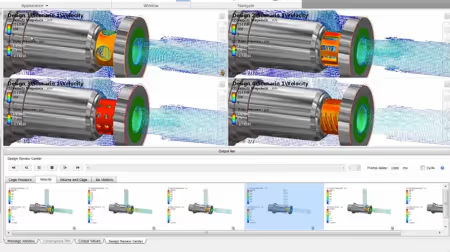
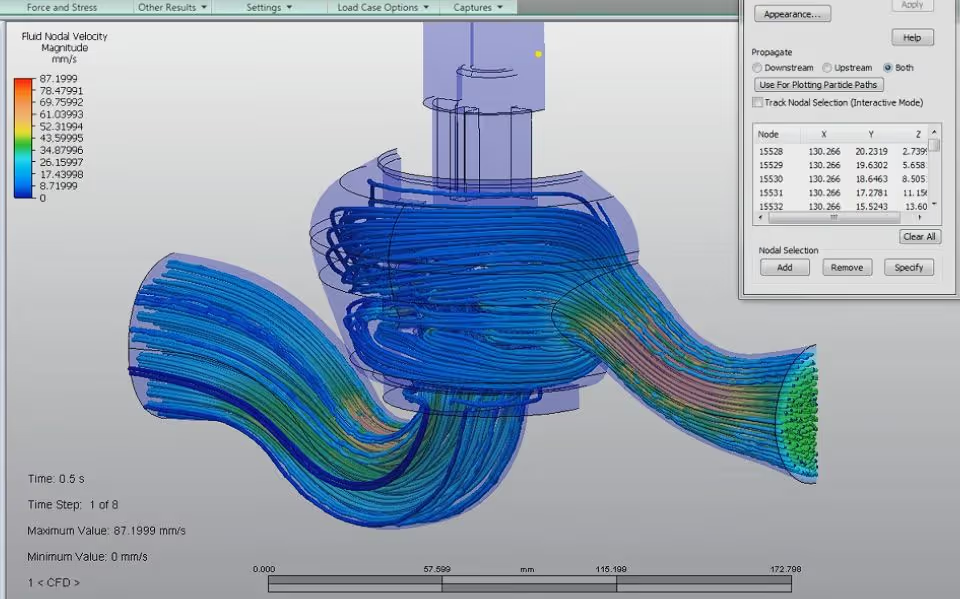
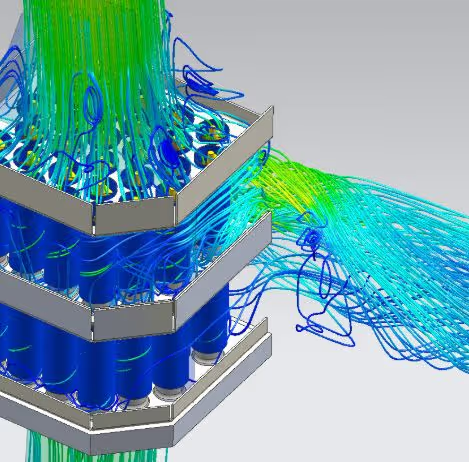
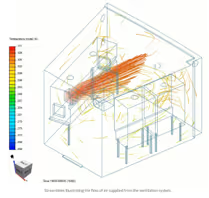
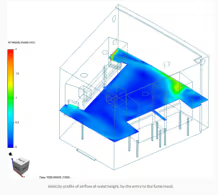
Our CFD consulting services provide deep insights into complex fluid behavior, allowing you to visualize and quantify flow patterns before a single piece of hardware is built. By simulating real-world physics, we help you eliminate guesswork, reduce prototyping costs, and ensure the safety of your industrial assets.
Core Applications & Use Cases
*Surge & Transient Analysis: Prevent catastrophic failure by modeling.
* Water hammer and harmful pressure waves in process piping.
* Thermal Management: Validate heat exchanger designs to maximize heat transfer coefficients and energy efficiency.
* Flow Optimization: Minimize pressure drop and optimize flow distribution in complex internal geometries.
* Instrumentation Measurement Integrity: Predict vortex shedding and turbulence intensities to ensure the accuracy of measurement equipment.
* Multiphase Dynamics: Analyze phase separation and interaction in liquid-gas, solid-gas, or immiscible liquid systems.
* Controlled Environments: Validate HVAC efficiency for cleanrooms and Data Centers, ensuring strict temperature and particle control.
* Process Equipment Verification: Rigorous design auditing for spray towers, isolators, and reactors to meet industrial standards.
Optimizing the Path from Concept to Energization
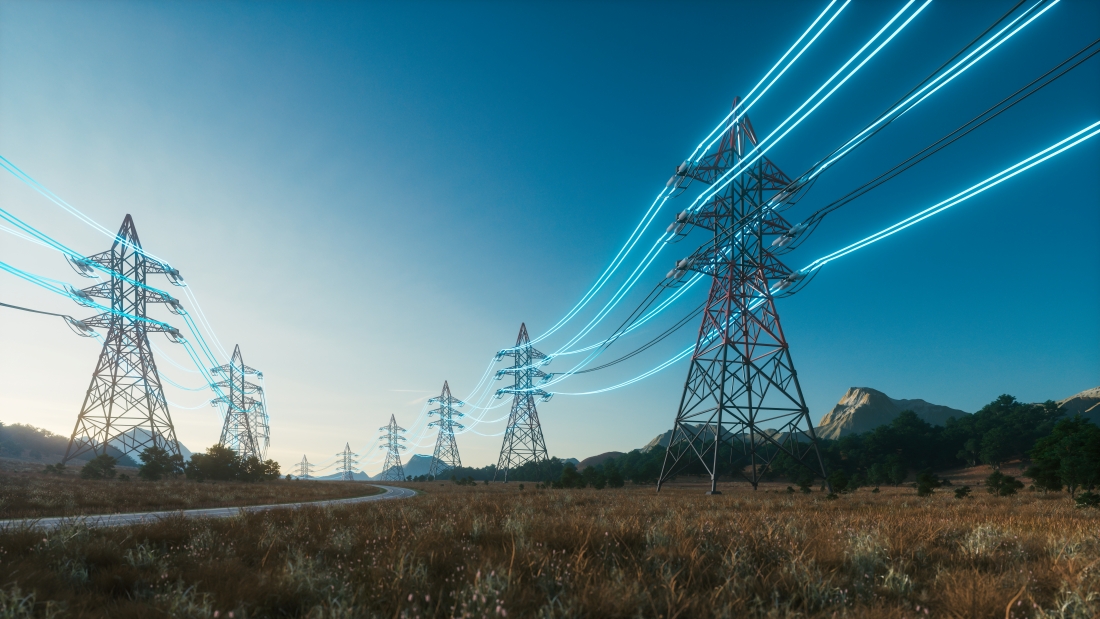
At treverdo, we eliminate the traditional bottlenecks of High Voltage (HV) Overhead Line (OHL) engineering. By centralizing our design philosophy within the PLS-CADD ecosystem—the global industry standard—we compress project schedules by integrating structural, electrical, and geospatial data into a single, high-velocity workflow.
1. Integrated Geospatial Intelligence
We bypass the "data silos" that typically delay early-stage engineering. By importing LiDAR, GIS, and photogrammetric data directly into PLS-CADD, treverdo creates a "Digital Twin" of the corridor. This allows for:
* Automated Optimum Spotting: Rapidly determining the most cost-effective tower locations while maintaining mandatory clearances.
* Instant Constraint Analysis: Real-time visualization of environmental, social, or technical "No-Go" zones.
2. Structural & Electrical Synergy
Our workflow links PLS-CADD directly with TOWER (for lattice structures) and PLS-POLE. This seamless integration means that a change in conductor tension or a shift in tower height is instantly reflected across the entire structural model.
"What-If" Scenario Speed: We can run hundreds of load-case simulations in a fraction of the time required by manual methods.
CAPEX Reduction: Precision nonlinear analysis allows us to optimize steel weight, often reducing material costs by 10–15% compared to conservative, non-automated designs.
3. Rapid Regulatory & Compliance Documentation
treverdo leverages the automated reporting engines within our software suite to generate "Submission-Ready" documentation at the click of a button:
Plan & Profile Sheets: Generated automatically from the 3D model, ensuring 100% accuracy between design and drawing.
Staking Tables & Stringing Charts: Delivered with surgical precision to the construction team, eliminating field-fit errors.
Clearance Verification: Sophisticated "Check Wind" and "Check Sag" routines ensure full compliance with IEEE/CIGRE or local utility standards from day one.
4. The Result: A Compressed Project Lifecycle
By front-loading technical certainty, treverdo typically reduces the Engineering Phase by 20–30%. We deliver a design that is not only "Well Done First Time" (WDFT) but is also optimized for the lowest possible Total Cost of Ownership (TCO).